Alec Leamas and Karl Riemeck
The Spy Who Came in from the ColdAlec Leamas and Karl Riemeck are handler and agent, bound by years of clandestine work and by a professional intimacy that never removes the need for concealment. Karl is Leamas’s most valuable source in East Germany, yet the relationship’s central contradiction is that the habits required to protect an agent—partial disclosure, changing procedures, suspicion—cannot fully protect either man from what the other keeps private. When Karl’s network is exposed and he is shot while trying to cross into the West, the partnership ends in failure, leaving Leamas to carry both its operational consequences and its personal cost.
Identity and Professional Partnership
Karl Riemeck is a senior East German Communist Party figure whom Leamas identifies as the best agent he ever knew. Karl appears on the Praesidium, and his position gives him access to material far beyond what Leamas would expect from an ordinary source. The intelligence attributed to him includes the minutes of a Praesidium meeting, a draft revision of East Germany’s relationship to COMECON, and a detailed account of the East German Intelligence Service, including departmental functions and personnel. When Peters doubts that Karl could have supplied so much alone, Leamas insists that Karl had the necessary access; that doubt later becomes important because it raises the possibility of a high-level collaborator whose identity is not yet known.
Their work is not simply an exchange of documents. Leamas runs an intelligence network in Berlin and is responsible for managing Karl alongside other agents and sources. The scale of what passes through their relationship makes personal confidence operationally consequential: an agent’s disclosures can expose not only himself but also meeting arrangements, communications, safe houses, and the people connected to the network.
Secrecy, Elvira, and the Fraying of Trust
A major breach begins when Karl introduces Leamas to Elvira, a woman he has kept secret. At a dinner attended by Leamas, Karl, and Control, the men later go to the Alter Fass, where Elvira is waiting. Karl presents her to Leamas as his best-kept secret. Leamas is furious, not because the evidence establishes that Elvira has already betrayed them, but because Karl has withheld a relationship whose existence might affect the security of his work.
Leamas demands to know what Elvira knows, who she is, and how Karl met her. Karl sulks and refuses to answer. Leamas then tries to change the routine, meeting places, and code words, but Karl resists the changes because he understands the suspicion behind them. He tells Leamas that, if Leamas does not trust Elvira, it is already too late. Leamas takes the warning and says no more, but from then on he tells Karl less and relies more heavily on espionage procedures. The episode shows the limits of the handler-agent bond: Leamas can alter procedures, but he cannot recover the knowledge Karl chose not to share or settle the question of what Elvira has learned.
By the time Leamas watches the crossing, he believes that Karl has allowed Elvira to know the whole network, including the safe house. He blames Karl’s omission and generalizes from it, privately resolving never to trust an agent again. That judgment is the product of both professional alarm and personal disappointment: Karl was the source Leamas trusted most, and the secret that has emerged is precisely the sort that makes trust dangerous.
The Crossing and Karl’s Death
At the checkpoint, Leamas sees Karl pushing his bicycle in an old military raincoat. Karl passes the document check and Customs, then waves to the man at the barrier as it lifts. For a moment the route seems open: Karl has passed the formal inspections and is approaching the remaining boundary between himself and safety. Leamas watches him from the checkpoint, convinced that Karl has made it through the first stages.
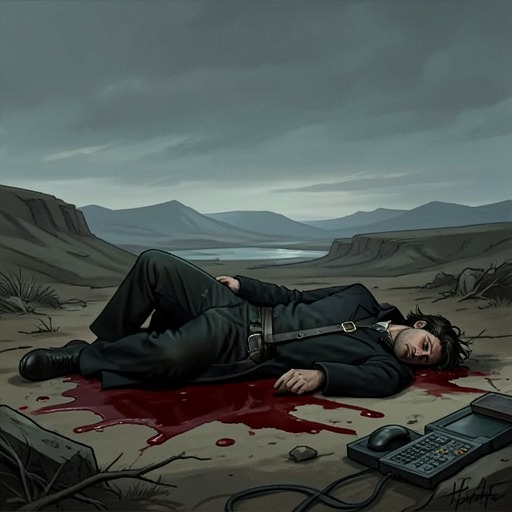
The apparent success reverses when searchlights come on and a siren sounds. Karl begins pedalling, and the East German sentry fires from his own sector. Karl continues forward briefly, but then falls from the bicycle. Leamas hopes that he is dead, a thought that records the immediate horror of a compromised escape as well as the brutal calculation forced on someone watching from the other side of the checkpoint. Later, Leamas tells Control simply that Riemeck is dead. Control responds that the loss is unfortunate and speculates that Elvira may have exposed him; Leamas does not ask how Control knew about her.
Operational Failure and Lasting Consequences
Karl’s death is not presented as an isolated loss. Leamas says that after revealing everything he knew about Karl, the Circus informed other departments, whose involvement made London increasingly demanding. Officials pressed for more intelligence and more money, and Leamas and his colleagues eventually suggested that Karl recruit additional sources so that those sources could form a network. Leamas calls this a disastrous decision: it placed further strain on Karl, endangered him, and undermined his confidence in his handlers. In his account, that pressure marked the beginning of the end.
The investigation after Karl’s death also exposes uncertainty about how much he could have obtained by himself. Peters argues that the intelligence attributed to Karl must have had help behind it. Leamas recalls that Control had asked a similar question about Karl’s access. The agreement between the two men troubles him because it suggests that Karl may have worked with another, more senior source. The relationship is therefore central not only to the loss of an agent but to a larger unresolved question about the intelligence network: the evidence credited to Karl may have been produced in collaboration, and someone else may remain hidden behind it.
Significance of the Relationship
The partnership’s decline joins private secrecy to institutional pressure. Karl conceals Elvira from Leamas; Leamas responds by withholding more from Karl; meanwhile, the intelligence service expands demands on a source whose existing position already makes him exceptionally exposed. No single adjustment restores confidence. The result is a relationship in which both operational knowledge and personal trust become incomplete, while the risks attached to each decision accumulate around Karl.
The wider setting sharpens that outcome. The Berlin Wall turns movement between East and West into a tightly controlled and dangerous undertaking, and the failed escape makes the boundary the final setting of the partnership. Leamas and Karl’s relationship ends not with a negotiated break or a clear account of every breach, but with Karl’s death and Leamas’s recognition that the network has been compromised. Its tragic force lies in the gap between Karl’s value to the service and the protection the service could provide: the best agent Leamas knew becomes the casualty of secrecy, exposure, and demands that the relationship could not withstand.